
§ 01 Start here
Group Transportation in Texas: Charter Buses, Shuttles and Vans for Every Kind of Group
Charter Bus Company Texas plans and runs group transportation across the state, from a 14-seat Sprinter van for a board visit to a line of 56-passenger coaches for a stadium crowd. This page is the front door. It explains how group travel by bus works, which vehicle fits which headcount, what changes the price and how to check a carrier. Then it sends you to the page written for your kind of group.
Every trip we book is a private charter. The vehicle, the driver and the schedule belong to your group for the whole booking, and no one outside your group boards. You tell us the people, the places and the times. We send back a vehicle plan and a written quote.
It's written for whoever ends up organizing the ride: an office manager, a coach, a youth pastor, a wedding planner, a festival producer or a parent with a group text. You don't need to know bus terms to use it. The definitions below explain the ones that affect your quote.
§ 02 Index of groups
Find Your Group: 15 Kinds of Group Transportation, Each With Its Own Planning Page
A wedding shuttle and a plant-shift commute both use buses, but they are planned in different ways. So each group type has its own page, with its own checklist, vehicle advice and planning tool. Open a drawer to narrow the cards, then pick the card that sounds like your trip.
GT 01Work
Corporate charter bus rental
For offsites, client days, plant tours, sales kickoffs and company retreats, booked by an office manager, an executive assistant or a planner. The page starts with a one-page budget memo and includes a shuttle cost estimator. It also explains the difference between booking one event and setting up an account.
- Usual fleet
- Coaches, mini buses, Sprinter vans
- Tool
- Shuttle cost estimator
GT 02Work
Convention shuttle bus rental
Written for meeting planners running hotel-to-venue loops during a conference or trade show. The page shows how to split hotels into lines, work out how often buses come, and add buses for the morning rush. It covers the main Texas convention centers and closes with a pre-con packet checklist.
- Usual fleet
- Coaches and shuttle buses on loops
- Tool
- Buses-by-hour show day chart
GT 03Work
Employee shuttle services
Recurring commutes for plants, warehouses, hospitals and office campuses. These run weekly or for a whole contract term, not for one day. The page covers shift-change timing, route shapes, a six-week launch plan, rider rules and the monthly report you should expect from your provider.
- Usual fleet
- Shuttle buses, mini buses, coaches
- Tool
- 24-hour shift dial
GT 04Work
Hotel shuttle bus rental
For general managers who want to stop running the house van themselves. The page helps you decide whether to keep the shuttle in-house or contract it out. It lists the services a contracted shuttle can cover, explains how the contract and billing work, and gives the steps for a breakdown or a weather call.
- Usual fleet
- Shuttle buses, Sprinter vans
- Tool
- Own vs outsource ledger
GT 05Work
Government and military charter bus rental
Unit moves, basic training graduations, agency field days and emergency staging at Texas installations and public offices. The page follows how funding gets approved, explains gate access and vehicle paperwork, and builds a movement request you can copy and send.
- Usual fleet
- Coaches with full luggage bays
- Tool
- Movement request builder
GT 06Teams
Sports team charter bus rental
For athletic directors, club team managers and booster clubs. The page plans around the game day schedule, covering road trips, tournaments and playoff runs that get booked on short notice. It works out how much gear fits under the bus and walks through a season's travel calendar.
- Usual fleet
- Coaches, school buses
- Tool
- Gear loadout calculator
GT 07Schools
School field trip charter bus rental
Written for teachers and front-office staff. The page includes a seat worksheet that counts students and chaperones, a trip-day bell schedule, the documents your district office will ask for and Texas museum and campus destinations sorted by subject.
- Usual fleet
- School buses, coaches
- Tool
- Seat and chaperone worksheet
GT 08Campus
College charter bus rental
For student organizations, Greek life, admissions and university departments. The page follows the academic calendar from move-in to commencement and covers the main Texas college towns. It also follows the approvals from advisor to risk management to purchasing.
- Usual fleet
- Coaches, mini buses
- Tool
- Approval routing slip
GT 09Faith
Church group charter bus rental
For youth camps, retreats, mission trips and senior adult outings. The page lists the Texas camps and pilgrimage routes groups drive to most, gives packing lists for the luggage bay, and compares a church van, a church bus and a chartered coach side by side.
- Usual fleet
- Coaches, mini buses
- Tool
- Van vs bus vs charter table
GT 10Celebrate
Wedding charter bus rental
Guest shuttles between hotels, the ceremony and the reception, planned by couples and wedding planners. The page covers loop timing so guests don't wait long and sample wording for your wedding website. It also includes a booking countdown that starts months before the date.
- Usual fleet
- Coaches, mini buses, party bus
- Tool
- Shuttle loop planner
GT 11Celebrate
Private event charter bus rental
For birthdays, reunions, bachelor and bachelorette weekends, winery tours and friends heading to a show together. The page is written for the friend organizing the group. It covers rally points, on-board rules, and which weekends cost more and fill up early.
- Usual fleet
- Party bus, mini bus, Sprinter van
- Tool
- Winery stop planner
GT 12Shows
Concert and festival transportation
This page is for the organizer side: promoters, venues and production teams. It covers park-and-ride lots, venue shuttles, artist and crew runs, and staff and volunteer loops. It also explains the paperwork, weather holds and how to get the crowd out at the end of the night.
- Usual fleet
- Coach and school bus fleets
- Tool
- Egress clearance calculator
GT 13Transfer
Airport charter bus rental
Group arrivals and departures at DFW, Love Field, Bush Intercontinental, Hobby, Austin, San Antonio and El Paso. The page explains the meeting point at each airport, how flight delays are handled, and why a single bus usually beats a line of rideshares.
- Usual fleet
- Coaches, shuttle buses, Sprinters
- Tool
- Fleet matcher
GT 14Transfer
Cruise port charter bus rental
Groups sailing from Galveston, coming from Houston airports, hotels or other Texas cities. The page covers the terminals, how far ahead to leave on embarkation day, luggage on the bus and the early pickup on debarkation morning.
- Usual fleet
- Coaches with luggage bays
- Tool
- Embarkation leave-by planner
GT 15Tour
Tour group charter bus rental
Multi-day trips for tour operators, senior travel clubs and groups arriving from overseas. The page covers driver hours, driver lodging, road books for Texas loops like Big Bend, and the parts that make up a multi-day quote.
- Usual fleet
- Coaches with restrooms
- Tool
- Driver hours checker
Showing all 15 group pages.
§ 03 Definitions
What Group Transportation Means, in Ten Terms
Quotes are easier to compare when you and the bus company use the same words. These are the ten terms that cause the most mix-ups on group charter bus quotes in Texas. Each one changes what you are buying, and most of them change the price.
chartergroup transportation
- charter n., v.
- 1. Hiring a whole vehicle and its driver for one group's exclusive use. The group sets the pickup, the stops and the times. 2. The opposite of buying seats on a scheduled intercity bus, where strangers share the ride and the timetable is fixed.
“We chartered two coaches, so the bus left when the last guest boarded.”
- CDL, passenger endorsement n.
- The commercial driver's license class and the “P” endorsement a driver needs to drive a vehicle designed for 16 or more people, counting the driver. Every bus on this site needs one. Most Sprinter vans fall under that line.
- deadhead n.
- Miles or hours a vehicle drives empty, such as coming from a yard in another city to your pickup, or going home after a one-way drop. You pay for deadhead even when no one is on board, so a quote with low deadhead is often the cheapest one.
- drop and return n.
- Two one-way trips instead of one long booking. The bus drops the group off, leaves, and comes back at an agreed time. This works for long events where a waiting bus would cost more than a second trip. Weddings and day-long conferences use it often.
- garage to garage n.
- A billing method where the clock starts when the bus leaves its yard and stops when it gets back, not when passengers board and leave. Ask about it whenever you compare hourly prices. Our charter bus rental cost page explains how this affects the total.
group transportationtransfer
- group transportation n.
- Moving a set number of people together, on their own schedule, in vehicles hired for them alone. The term covers one-time charters, repeating shuttles, transfers and multi-day tours. In Texas that ranges from a van of ten to a convoy of coaches.
- motorcoach n.
- The full-size highway bus, usually 45 feet long with about 56 reclining seats, luggage bays underneath and, on most, a restroom. People use “charter bus,” “coach bus” and “motorcoach” to mean the same vehicle. See the charter bus page.
- multi-day charter n.
- One vehicle and driver kept with a group for two or more days. The quote includes a day rate, the driver's hotel room and enough rest time under federal hours rules. The tour group page covers it in detail.
- shuttle n.
- A vehicle running the same short route over and over during a set time, such as hotel to venue every 15 minutes from 7 to 10 a.m. Riders come and go instead of all boarding at once. You plan a shuttle around how often a bus comes, not around one pickup time.
“Two shuttle buses on a 30-minute loop gives a pickup every 15 minutes.”
- transfer n.
- A single one-way move from point A to point B with no waiting at the far end, such as airport to hotel or hotel to cruise terminal. Transfers are often priced as a flat trip instead of by the hour, with a minimum charge.
See alsoCharter bus rental costConvention shuttle planningAirport transfersFAQ
§ 04 Sorting desk
The Group Trip Router: Four Answers, One Vehicle Plan
Most group trips can be sorted with four facts: how many people, what shape the day takes, why the group is traveling, and what they're carrying. Answer them here and the router suggests a trip type and a starting vehicle mix, then lights up the page written for your group. It doesn't save or send anything.
Round trip charter
Why headcount comes first
Seats are the hardest limit. A coach seats about 56, and once the 57th person signs up you need a second vehicle. The router fills coaches first, then adds the smallest vehicle that covers whoever is left. That is usually cheaper than two half-empty coaches.
Why the shape matters
A loop is sized by how many people ride in the busiest half hour, not by the total. A transfer has no waiting time to pay for. A multi-day trip needs a vehicle with a restroom and a driver's hotel room. The same 120 people can need three vehicles or five depending on the plan.
What the router can't see
It doesn't know about parking limits, a gate that won't fit a 45-foot coach, or a ranch road after a rain. Treat the result as a starting point. A quote request gets a person to check it against your actual addresses and times.
See alsoCompare vehiclesSizing a shuttle loopMulti-day trips
§ 05 Vehicles
Six Group Vehicles, Sized by the Seat
Each green square below is one seat. A group bus rental starts with matching your headcount to a vehicle, then checking that vehicle for luggage, restrooms, accessibility and parking. Every vehicle has its own page with photos and details, and the vehicles page shows them side by side.
 10–14 seats
Sprinter van
The smallest vehicle we run, with high-roof standing room and individual seats. It fits in hotel drop-off lanes and parking garages where a bus can't go. Space for suitcases is limited, so a full van with bags may need a second van or a mini bus.
Best forexecutive visits, small airport pickups, winery days
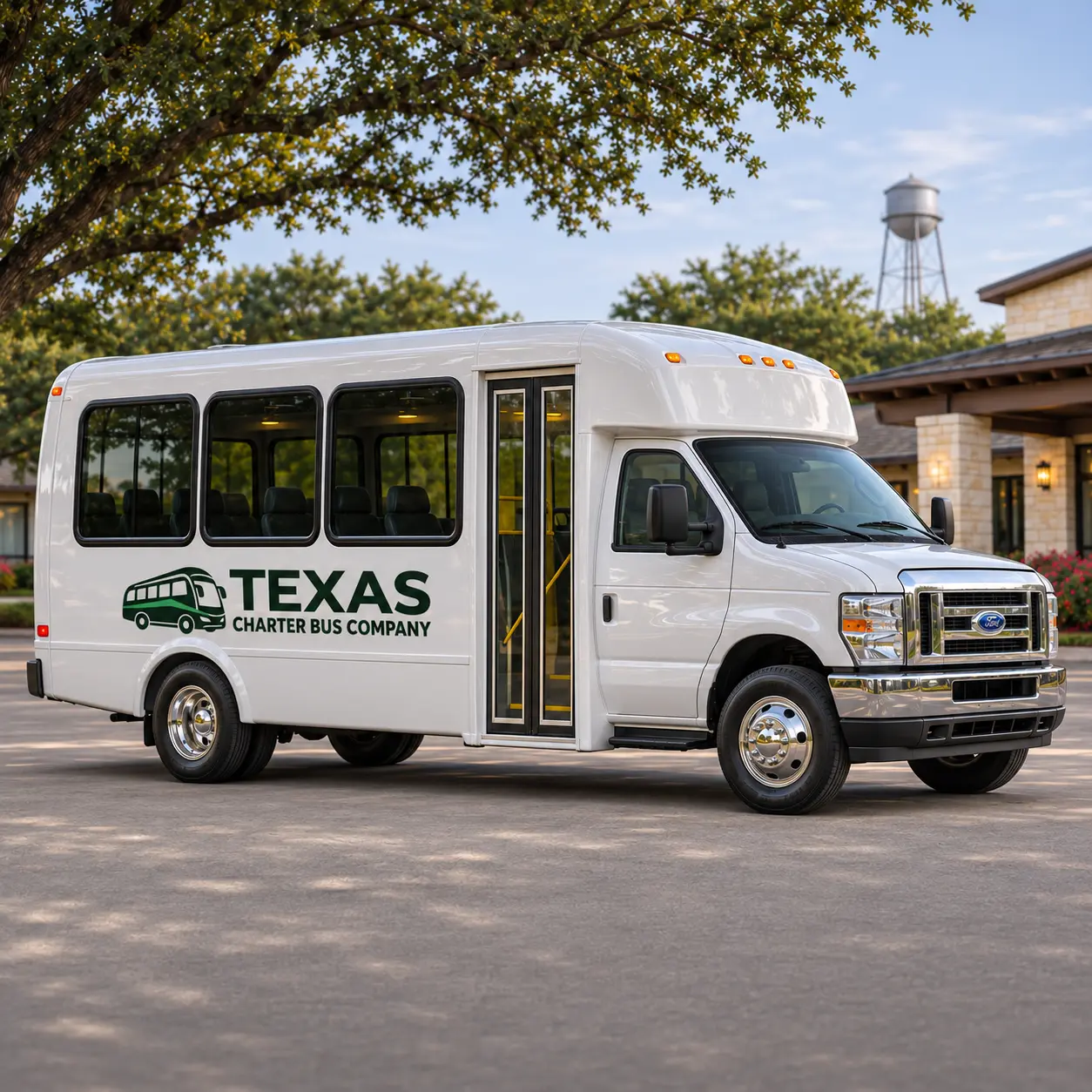 20–35 seats
Mini bus
The middle size, and often the most cost-effective one. It's big enough for a youth group, a wedding party or a department offsite, and short enough for tight church lots and downtown curbs. Luggage space depends on the model, so tell us if everyone brings a suitcase.
Best forwedding parties, youth groups, student organizations
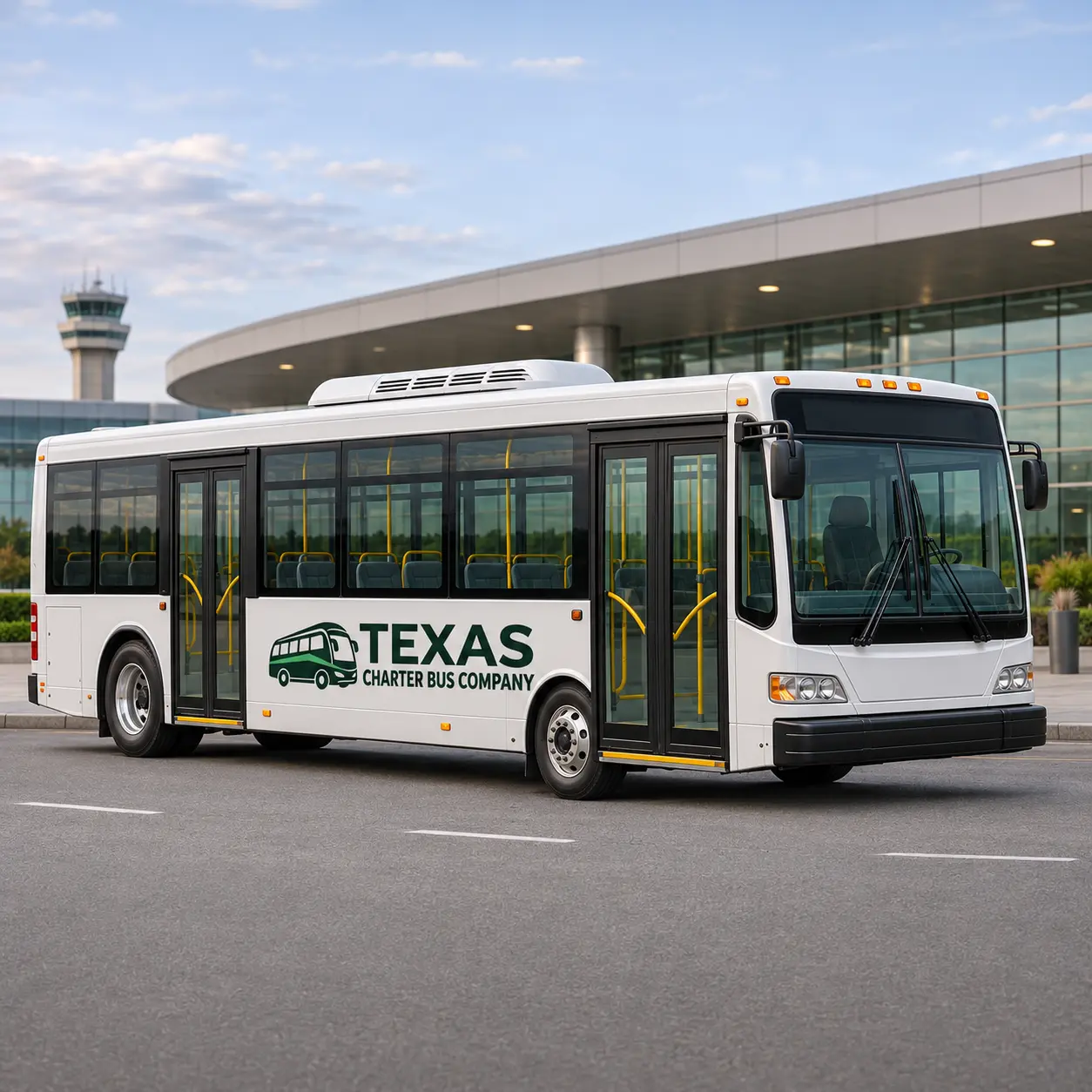 18–40 seats
Shuttle bus
Built for frequent stops, with quick boarding, room for standees on some models and an easy step-up. It's the workhorse for loops, where riders board and get off every few minutes. It isn't the best choice for a long highway drive.
Best forhotel shuttles, employee commutes, convention loops
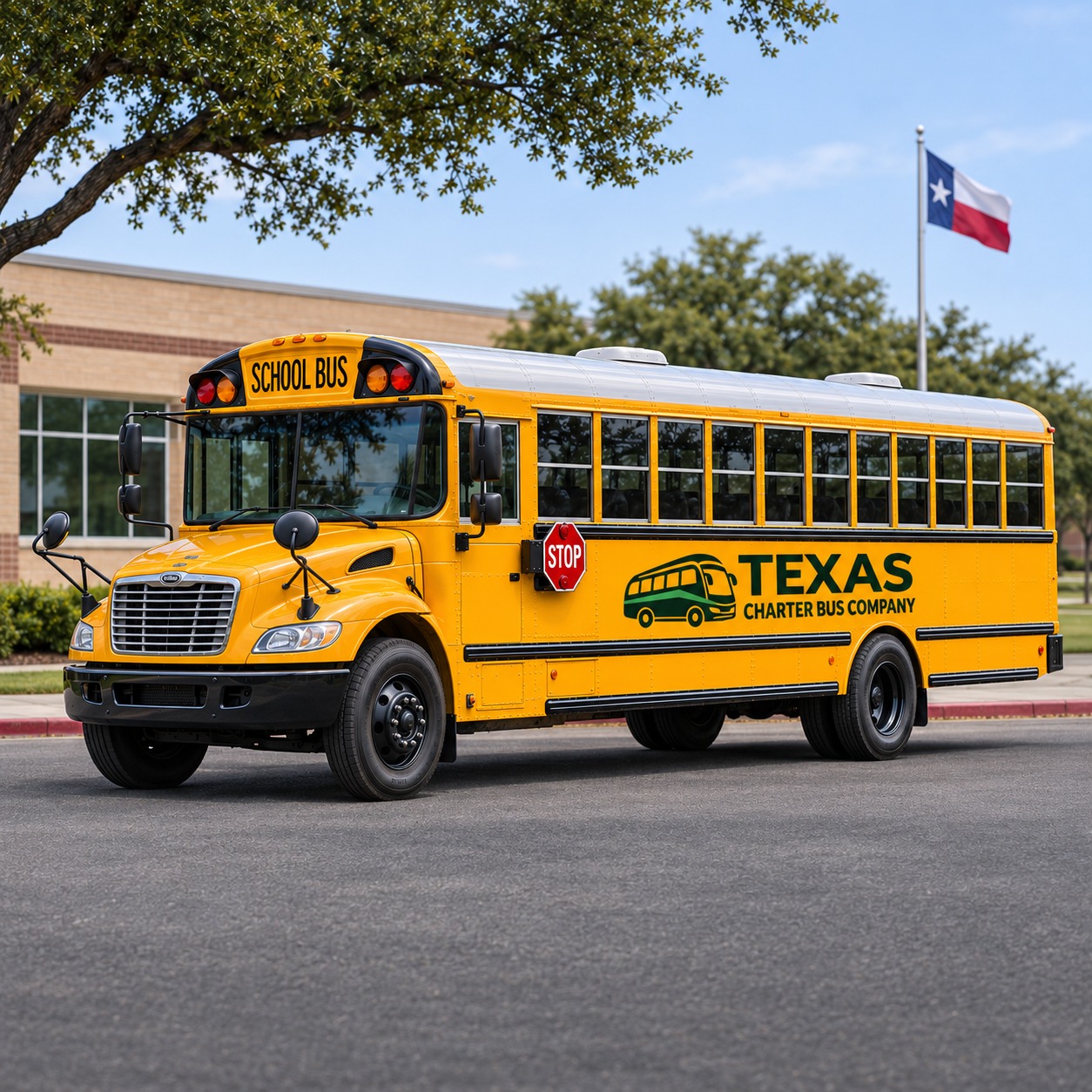 44–48 adults
School bus
Bench seats rated for about 72 small children or about 44 to 48 adults. It has no restroom and no luggage bays, so it suits short local runs. Many districts and parking crews recognize the yellow bus right away, which can make drop-offs smoother.
Best forfield trips, local games, park-and-ride lots
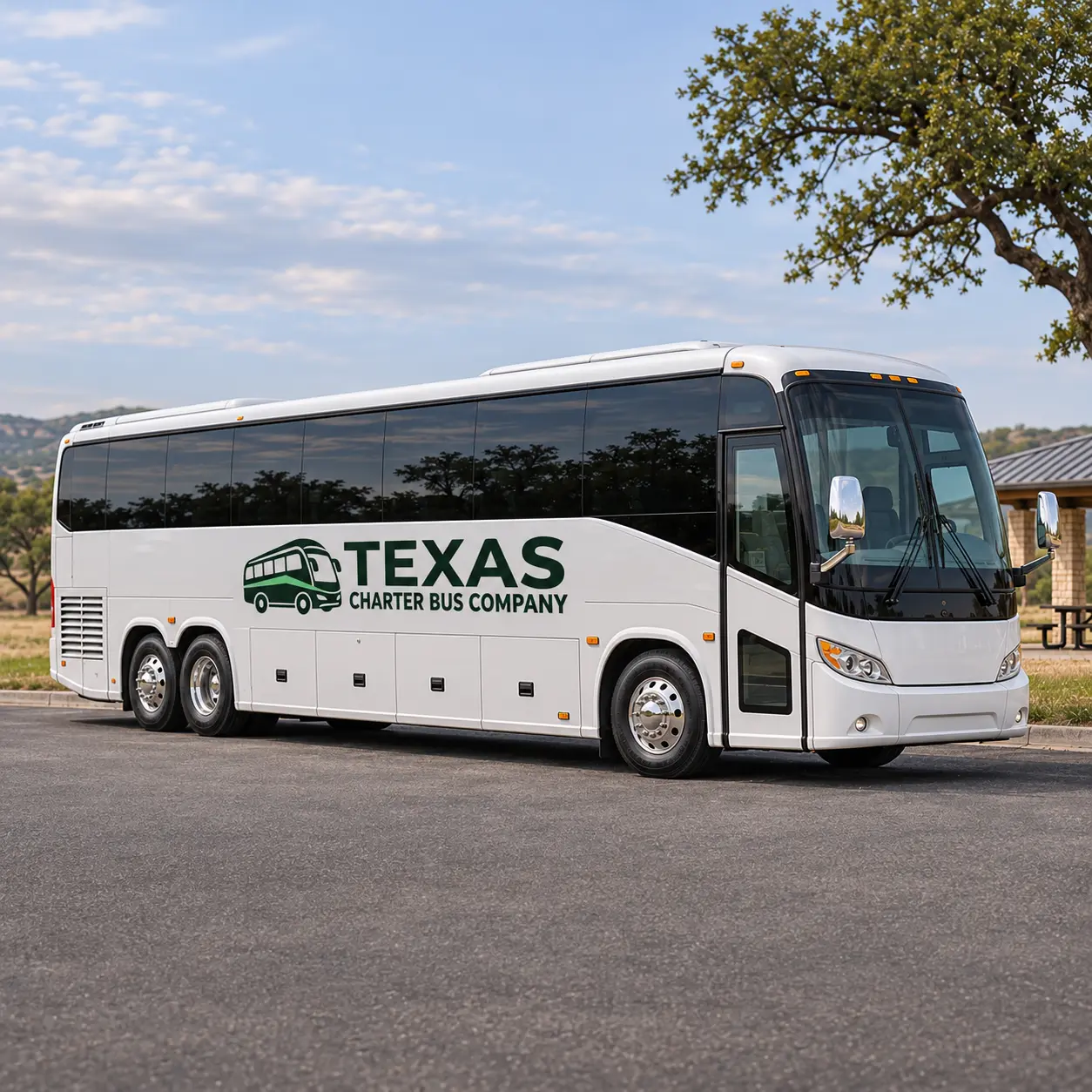 About 56 seats
Charter bus
The full-size motorcoach, with reclining seats, overhead racks, luggage bays underneath and a restroom on most coaches. It's the default for highway trips over an hour and for any group that won't fit in a smaller vehicle. Check that the stop has room for a 45-foot bus.
Best fortours, cruise transfers, unit moves
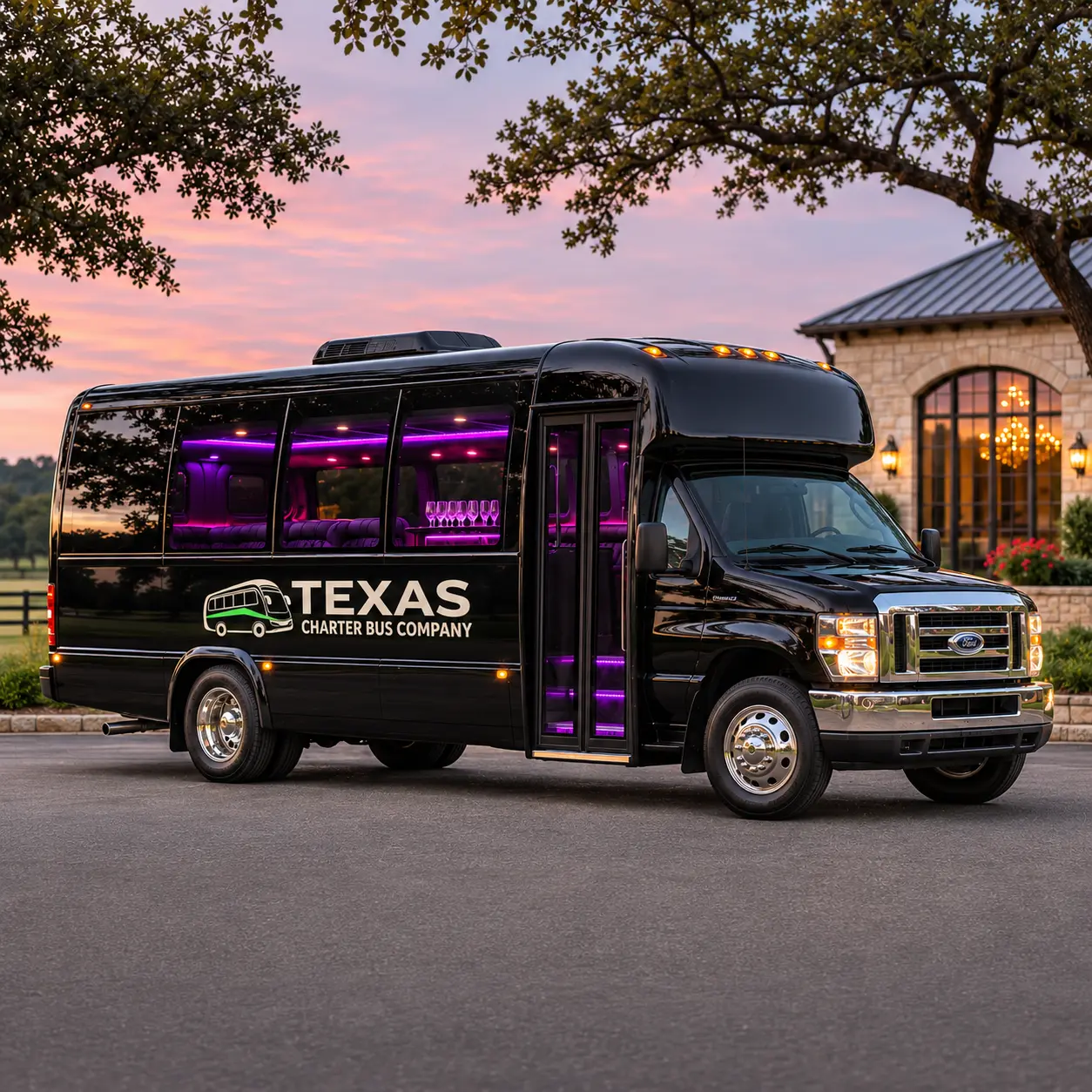 Varies, ask us
Party bus
Lounge seating along the sides, lighting and a sound system. It's built for the ride to be part of the night out, not for a long highway drive. Seat counts differ between vehicles, so we confirm the exact number for your date when we quote.
The sizing rule we quote by: count the riders, then plan for about 10 percent more. People join late, a chaperone gets added, a speaker brings a guest. A spare row is cheaper than a second vehicle booked at the last minute. If your group is right on a vehicle's limit, such as 54 people for a 56-seat coach, ask whether the next size up costs much more. Often it doesn't.
Between two sizes?
Choose the larger vehicle when the trip is longer than an hour, when everyone brings a bag, or when the group includes adults on bench seats meant for children. Choose the smaller one when the stop is a tight curb, a garage or a gated venue, or when you're paying for long waits. For 40 to 50 people on a local day trip, a school bus can cost less than a coach.
When two vehicles beat one
Splitting a group can make the day run better, not just fit more people. One bus can leave early with setup crews or speakers while the second waits for the main group. A small van can carry the people who need to leave early. Each vehicle gets its own driver, and dispatch keeps their times in sync.
See alsoAll vehiclesBrowse the fleetGear and luggage for teams
§ 06 Distances
Texas Is Bigger Than Your Itinerary: A Mileage Chart for Group Trips
The same 50 people cost very different amounts to move from Austin to San Antonio than from Houston to El Paso. Distance decides how many hours you're billed, whether you need a second driver and whether the trip has to stop overnight. Pick any two cities in the chart to see the miles and the realistic drive time for a coach.
Approximate road miles between Texas cities
| Amarillo | Lubbock | El Paso | Dallas | Houston | Austin | San Antonio | Corpus Christi |
|---|
Houston to Dallas
240road miles
Distances are rounded and assume the usual interstate route. Check DriveTexas, run by TxDOT, for closures and construction before you set the times.
Heat is a schedule item
From June to September, a bus parked in the sun for hours gets hot inside fast, even with good air conditioning. Ask for the driver to start cooling the bus before pickup, plan shade at the meeting point, and keep water on board for long waits. Ranch, stadium and festival lots are the worst places for this.
I-35 and the metro rush
The I-35 corridor between San Antonio, Austin, Waco and Dallas is the busiest stretch most groups use, and construction zones move every year. A trip that takes three hours at 10 a.m. can take four and a half at 4 p.m. on a Friday. Leave earlier than your map app says.
Storm season on the coast
From June to November, Gulf storms can close roads to Galveston and Corpus Christi or change cruise times. Watch the National Hurricane Center in the week before a coastal trip. We'll call you if a forecast changes the plan.
North Texas
Dallas, Fort Worth, Arlington and the suburbs make up one metro, but it takes an hour to cross it at rush hour. Most of our corporate and stadium trips start here. Teachers can read our Perot Museum bus arrival guide.
Houston and the Gulf Coast
Two airports, the state's largest convention center and the Port of Galveston are about an hour apart. Cruise groups should read Port of Galveston group drop-off and our Hobby Airport meeting point guide.
Austin and the Hill Country
Capitol field trips, campus events and ranch weddings on narrow two-lane roads. Read the Bullock Museum school bus drop-off notes and Austin to Dripping Springs shuttle timing before you set a schedule.
San Antonio and South Texas
Military graduations, River Walk conventions, and coastal runs to Corpus Christi and the Rio Grande Valley. Base visits need gate paperwork ahead of time, which our government and military page walks through.
West Texas and the Panhandle
El Paso is closer to Phoenix than to Houston. Lubbock and Amarillo trips are usually college and team travel. Big Bend loops need a careful driver-hours plan, covered on the tour group page.
See alsoAll trip guides on the blogDriver hours on long toursHow distance affects cost
§ 07 Lead times
When to Book Group Transportation: The Eight Dates That Matter
The right lead time depends on the season and the size of the fleet you need, more than on the type of group. One mini bus on a Tuesday in February is easy to book. Twelve coaches on a Saturday in May are not. Read the sheet from left to right, starting with the stamp that matches how far away your trip is.
26weeks out
Large fleets and big weekends
Festivals, conventions with several hotel lines, stadium events and peak-season weddings. When you need ten or more vehicles at once, they come from a shared pool that every other group in the city is booking from too.
12weeks out
Multi-day trips and peak months
Tours, mission trips, band trips and anything in March, May, October or December. Multi-day trips need the same driver and coach for the whole trip, so the vehicle is held for every day.
6–8weeks out
The normal window
Most one-day charters, field trips, corporate outings and airport groups. You'll have a full choice of vehicles and time to compare quotes. Send a rough headcount now and the final count later.
2–4weeks out
Short notice, still possible
Playoff games, added sessions and replacement buses. We can often cover it, but you may get a different vehicle mix than you wanted. Call instead of using the form, so we can check availability while you're on the phone.
14days out
Final count and full itinerary
Send the final headcount, every stop address, the contact on site and any accessibility needs. This is also when parking, gate access or venue loading rules need to be confirmed.
72hours out
Driver and vehicle details
You get the driver's name, the vehicle and the dispatch number for the day. Pass them to whoever is running the curb, such as a teacher, a planner, a coach or the best man.
24hours out
The confirmation call
We go over the timeline, the first pickup and any weather or traffic concerns with you. If a stop has changed, say so now, not at the curb. A late change can push the route past the driver's legal hours.
0day of travel
Staged early, counted on board
The bus arrives before the pickup time so boarding can start on schedule. Have your group leader do a head count before every departure, not only the first one. That's how no one gets left at a rest stop.
Texas months that fill up first
Yellow months are the busiest across the state. March brings spring break and big Austin events. May has graduations and weddings. October has fall festivals, football and the State Fair in Dallas, and December has holiday parties. Book these months earlier than our usual six to eight weeks. Each group page shows the busy weeks for that kind of trip.
See alsoWedding booking countdownAcademic calendarRefund and cancellation policy
§ 08 Price
What Moves a Group Charter Bus Quote Up or Down
Group transportation is priced by vehicle, not by seat, so the number of people matters less than when you travel, how long the vehicle is yours and how far it has to come. Tick the conditions that fit your trip and watch the scale. For hourly minimums and sample rates, see our charter bus rental cost guide.
Leaning higher
The scale shows which way things lean, not a price. Your quote is still worked out from your real dates and addresses.
Read the line items
A complete quote shows the base rate, the minimum hours, any empty-mile charge, the driver's lodging and how tolls, parking and permits are handled. Gratuity should be listed on its own line so you know whether it's included or left to you.
Compare like with like
Before you compare two quotes, line up the hours, the vehicle size and the age of the fleet. A quote that bills from first pickup to last drop-off can look cheaper than one that bills from when the bus leaves the yard, even if it isn't. Ask each company which clock it uses.
Per person, for the budget
Divide the total by the number of riders when you budget or collect money from the group. A full 56-seat coach almost always works out cheapest per person. Leaving 15 seats empty to keep one vehicle is often still cheaper than adding a van. Our corporate page has a shuttle cost estimator for multi-hour programs.
See alsoCharter bus rental costRefund and cancellation policyTerms and conditions
§ 09 Carrier check
Six Checks Before You Hand a Bus Company Your Group
The checks are the same whether the group is 12 executives or 400 eighth-graders. Each one takes a few minutes and uses public records or documents the carrier should send you when asked. Mark each one off as you go. When all six pins are set, the lock opens.
0 of 6 checks done
Read our own safety commitment.A USDOT number that matches the company name
Look the number up on the FMCSA SAFER Company Snapshot. Check that the legal name matches the contract, the status is active and the company is listed as a passenger carrier. Trips that stay inside Texas also need state motor carrier registration, which you can look up through TxDMV.
A certificate of insurance in your name
Federal rules set a $5 million minimum of liability coverage for interstate for-hire carriers of 16 or more passengers, and $1.5 million for smaller vehicles (49 CFR Part 387). Ask for a certificate that names your school, church, company or venue as the certificate holder, with the trip dates covered.
A safety record you have read yourself
The same SAFER page shows inspections, out-of-service rates and crashes for the last two years. A few inspections are normal for an active fleet. A pattern of out-of-service orders isn't. FMCSA's passenger safety page lists more red flags to watch for.
Licensed, drug-tested drivers
Every bus driver needs a commercial driver's license with a passenger endorsement. Carriers must also run drug and alcohol testing and check each driver in the FMCSA Drug and Alcohol Clearinghouse. Ask how drivers are screened and trained, and whether the same driver stays with your group for a multi-day trip.
A schedule that fits legal driving hours
A passenger-carrier driver may drive up to 10 hours after 8 hours off duty and may not drive after 15 hours on duty (49 CFR 395.5). If a quote has one driver on a 16-hour day, the carrier is either planning to break the rule or hasn't read your itinerary.
The right vehicle, inspected, with access if you need it
Ask for the vehicle type and model year in writing, and how often the fleet is inspected. If a rider uses a wheelchair, ask for a lift-equipped vehicle when you book. Federal rules for over-the-road buses (49 CFR Part 37, Subpart H) let the company ask for up to 48 hours' notice. See ADA.gov for rider rights.
See alsoSafety commitmentCarrier report card for schoolsAbout us
§ 10 Field notes
Group Travel Guides From the Curb: Field Notes for Specific Texas Stops
The group pages cover how to plan. These guides cover where to stop: which curb, which gate and how many minutes the drive really takes at one Texas destination. They're short and specific, and each one comes from questions groups have asked before a real trip.
Perot Museum Field Trips: A Bus Arrival Guide for Teachers
The route the museum wants buses to take, planning back from your entry time, seat math with a 1:7 chaperone ratio and a one-page card for your driver.
Dallas · School groupsWhere Can School Buses Unload at the Bullock Museum?
The two loading zones, the approach to 18th Street, a minute-by-minute unload plan, where the bus goes after drop-off and the days when that curb gets harder.
Austin · School groupsWhen Should Your Wedding Shuttle Leave Austin for Dripping Springs?
Why a 24-mile ride needs a 90-minute head start, a departure time worksheet, sunset times by month and two sample wedding day shuttle schedules.
Hill Country · WeddingsWhere Do Galveston Cruise Groups Meet Their Bus at Hobby Airport?
How the arrivals level is laid out, choosing a meeting point people can find, groups landing on different flights and the time math from Hobby to boarding.
Houston · Airport and cruiseHow to Find Your Group Drop-Off Point at the Port of Galveston
Which pier your ship uses, drop-off notes for each terminal, the curb rules drivers follow, a 15-minute unload plan and a checklist for the group leader.
Galveston · Cruise groups
See alsoThe full blogSchool field trip guidesCruise transportation guidesWedding guides
§ 11 Questions
Group Transportation FAQ: Questions Groups Ask Before They Book
These answers apply to every kind of group. Questions about one group type, such as permission slips, cruise luggage or festival egress, are answered on that group's page and on our main charter bus FAQ.
Ask the Dispatcher
Group travel deskWhat exactly is group transportation, and how is it different from renting a bus?
Renting a bus usually means you get a vehicle. Group transportation means you get a vehicle, a licensed driver, a route plan and a schedule built around your group. The vehicle is yours for the booking, no one else boards, and it waits or comes back at times you set. Every booking with us includes the driver, because a bus rental in Texas without a commercial driver isn't something a group can legally drive away with.
How many people can you move at once?
One booking can be a single Sprinter van for ten people or a fleet of coaches for a few thousand riders over a day. For big moves we plan in waves: how many vehicles load at once, how long a round trip takes and how many trips you need. The festival and convention pages show how those numbers are worked out.
My group fits two categories. Which page should I read?
Read the page for the organizer, not the destination. A company taking staff to a festival is a corporate trip. A church youth group flying out of DFW starts on the church group page and borrows the airport tips. If you're still unsure, one quote request covers both, and we'll plan it as a single trip.
Do you cover all of Texas? Can a trip leave the state?
Yes. Trips start in every major Texas metro and in smaller towns between them, and we place vehicles where they need the fewest empty miles to reach you. Trips can cross into neighboring states, such as a choir tour to Oklahoma City or a team trip to Shreveport, under the same safety and driver-hours rules. Tell us every overnight stop when you request the quote.
How far ahead should a group book?
For one or two vehicles on a normal date, six to eight weeks is usually enough. For ten or more vehicles, a peak weekend, or any trip in March, May, October or December, book three to six months ahead. Short-notice trips are possible, so call instead of waiting for a reply to the form. The booking timeline above covers the final two weeks.
Is a charter bus cheaper than vans or rideshares for a group?
From about 20 people up, a single bus usually costs less per person than several vans or a line of rideshares. It also removes the problems of volunteer drivers, fuel receipts and people arriving at different times. Below that, a Sprinter van is often the better buy. The church page compares church vans and charters side by side, and the cost guide explains hourly minimums.
Can one booking mix different vehicles?
Yes, and it's often the cheapest way to fit an awkward headcount. Two coaches and a mini bus can cost less than three coaches. A Sprinter for the speakers and coaches for the delegates keeps the VIP schedule separate from everyone else's. Each vehicle gets its own driver and its own line on the quote, all coordinated by one dispatch team.
What do you need from me to send a quote?
The date, the number of riders, every pickup and drop-off address, the times you need to arrive and leave, and anything unusual. That includes luggage, equipment, a wheelchair user, a gate with security checks or a venue with loading rules. A rough plan is fine to start. Use the quote form, or call and we'll fill it in with you.
Do you have wheelchair-accessible vehicles?
Yes. Ask for a lift-equipped vehicle when you book and tell us how many riders use mobility devices. Federal rules let over-the-road bus companies ask for up to 48 hours' notice, but for a group trip we'd like to know when you first request the quote. That way the accessible vehicle is the one your whole group rides, not a separate van.
What happens if our headcount changes after we book?
Tell us as soon as you know. Adding people usually means a larger vehicle or one more, depending on what's free on your date. Fewer people can mean a smaller vehicle if there's still time to switch. Deposits, changes and cancellations follow our refund and cancellation policy, which you'll see before you sign.
Have a question that isn't here? Call the desk at (308) 304-6668 or send us a message.
§ 12 Next step
One Quote Request Covers Any Group, Anywhere in Texas
Tell us the date, the headcount and the stops. You'll get a vehicle plan and a written quote with every line item shown. If you don't know which group page fits, send the request anyway and tell us about the trip in your own words.
- 1We read the trip. A planner checks the addresses, times and headcount against the vehicles free on your date, and calls if something doesn't add up.
- 2You get a plan and a price. The quote names each vehicle, the hours, the empty miles and any lodging, tolls or fees, so you can compare it with any other quote.
- 3You confirm, we lock it in. A signed agreement and deposit hold the vehicles. Final details are due two weeks out, and driver details come three days before.
Prefer email? Write to booking@charterbuscompanytexas.com or use the contact page.